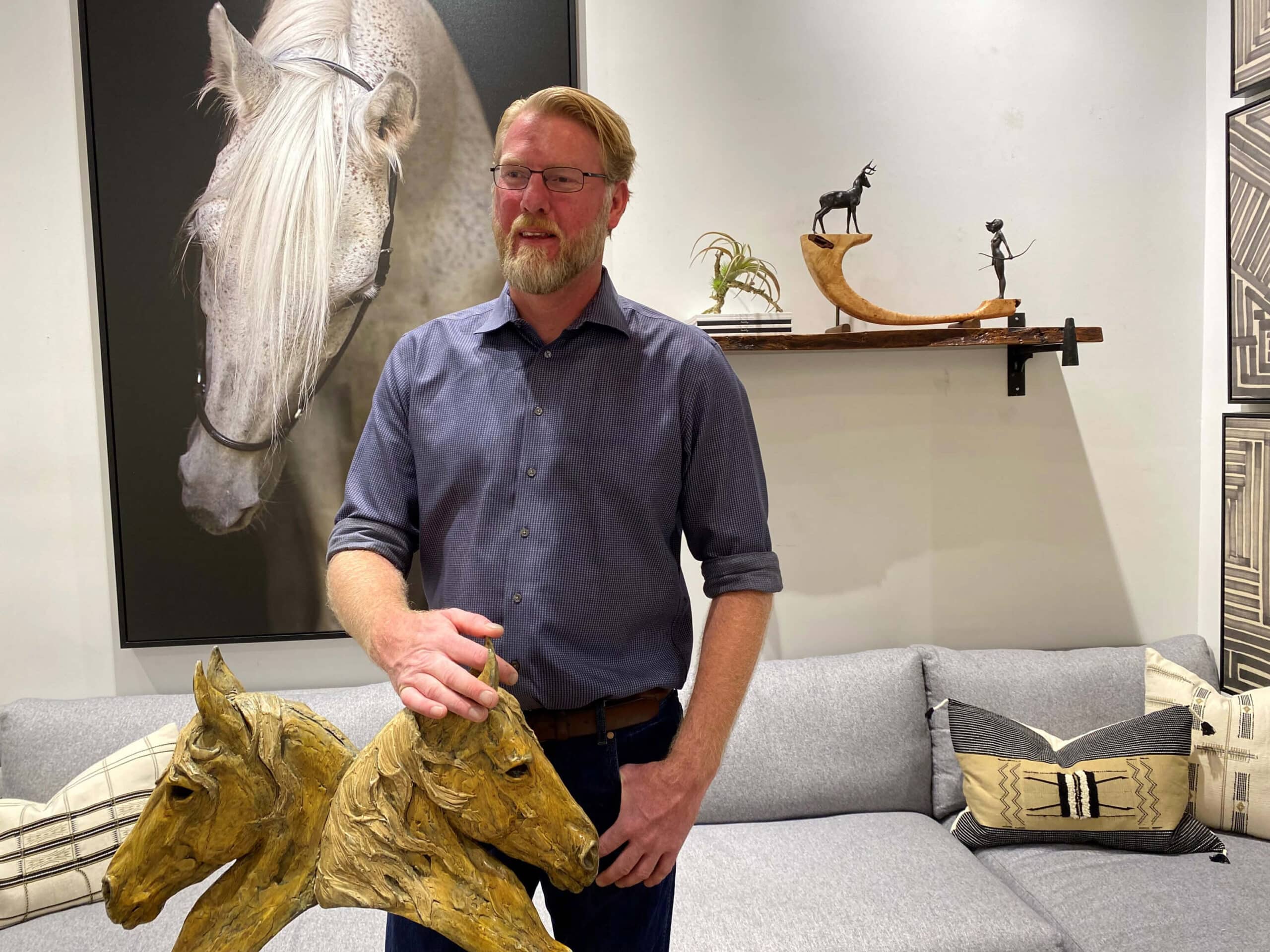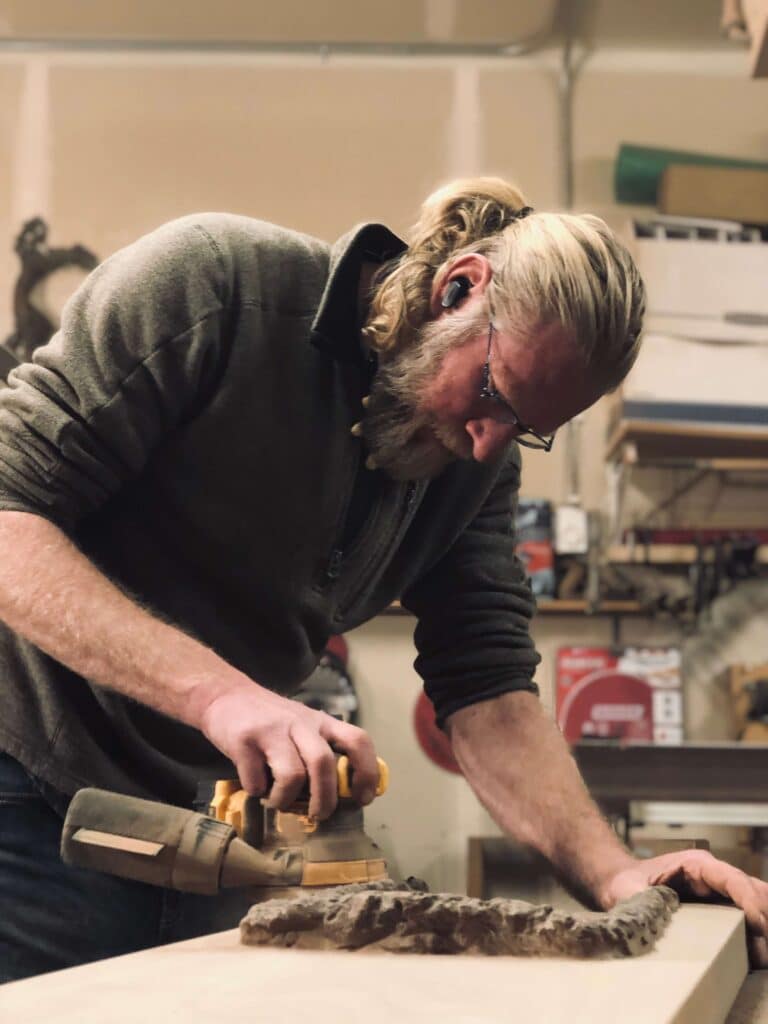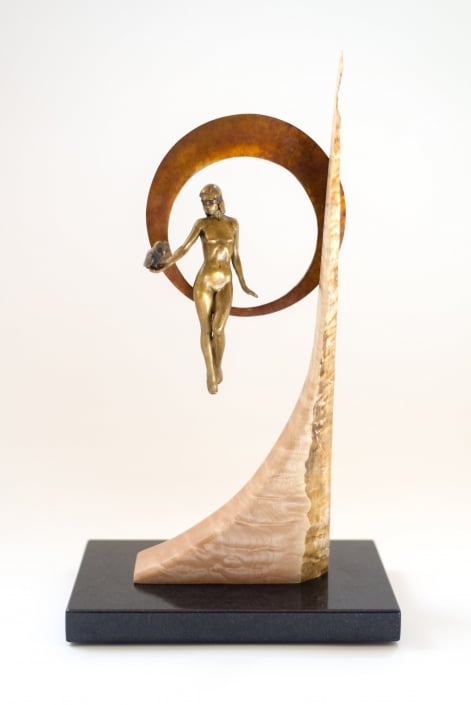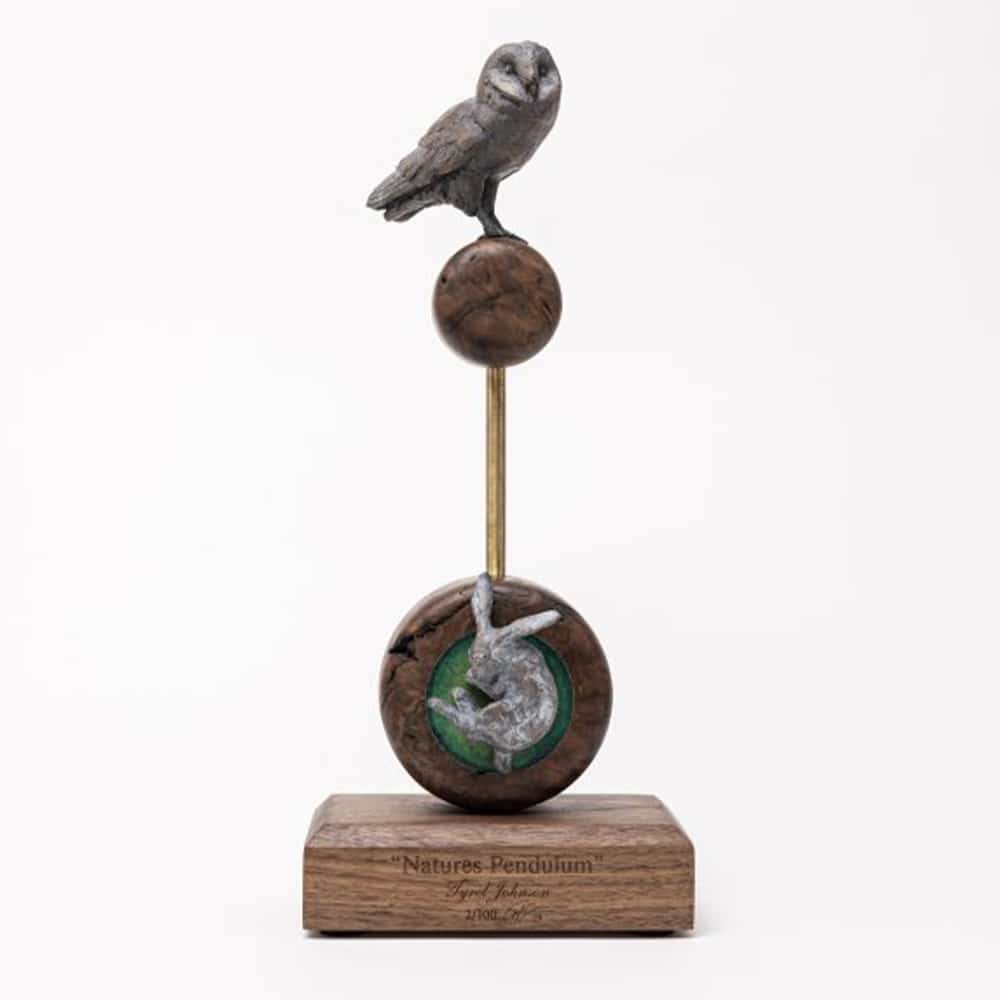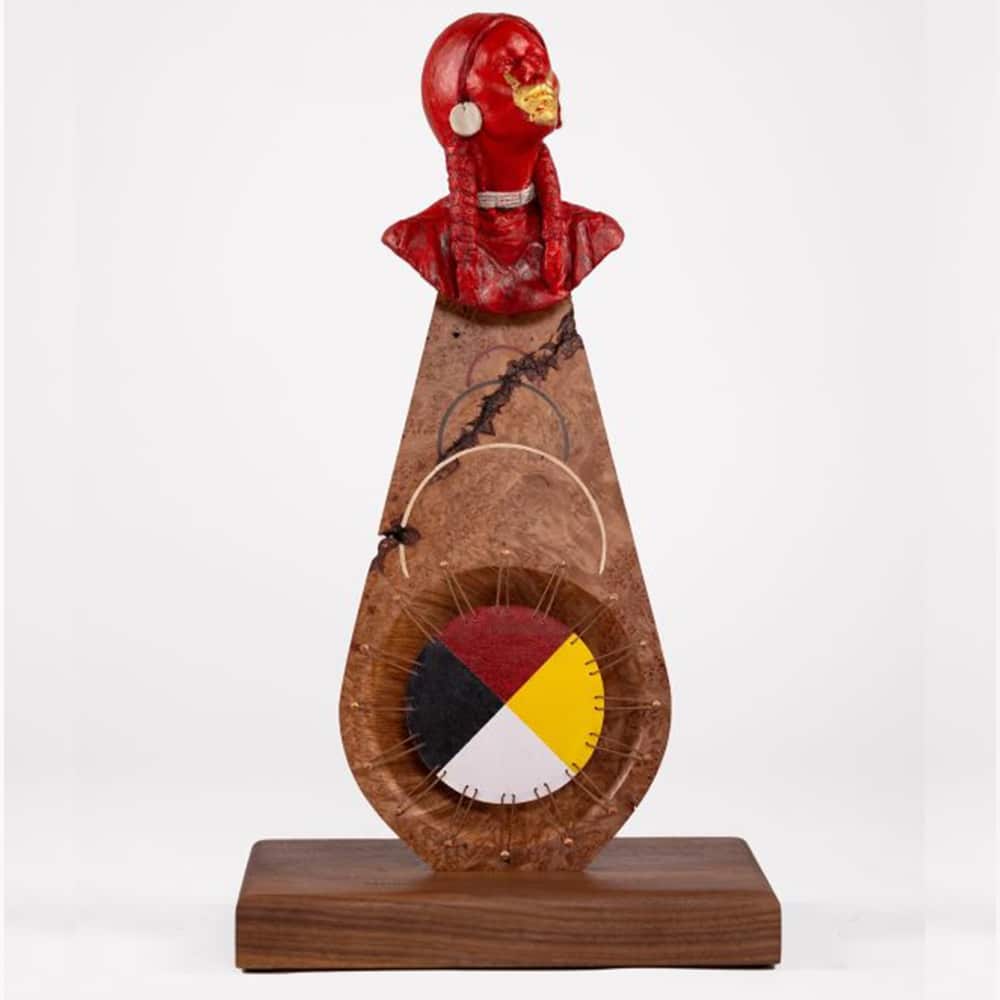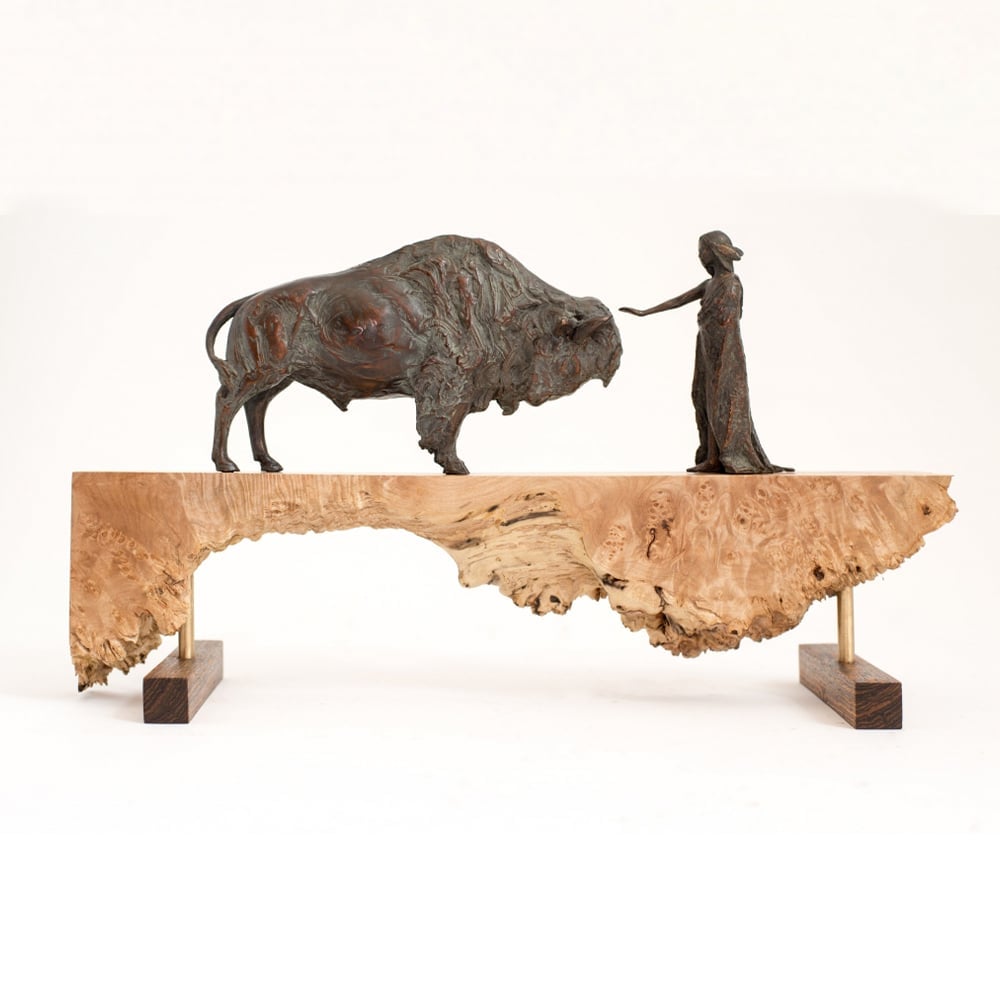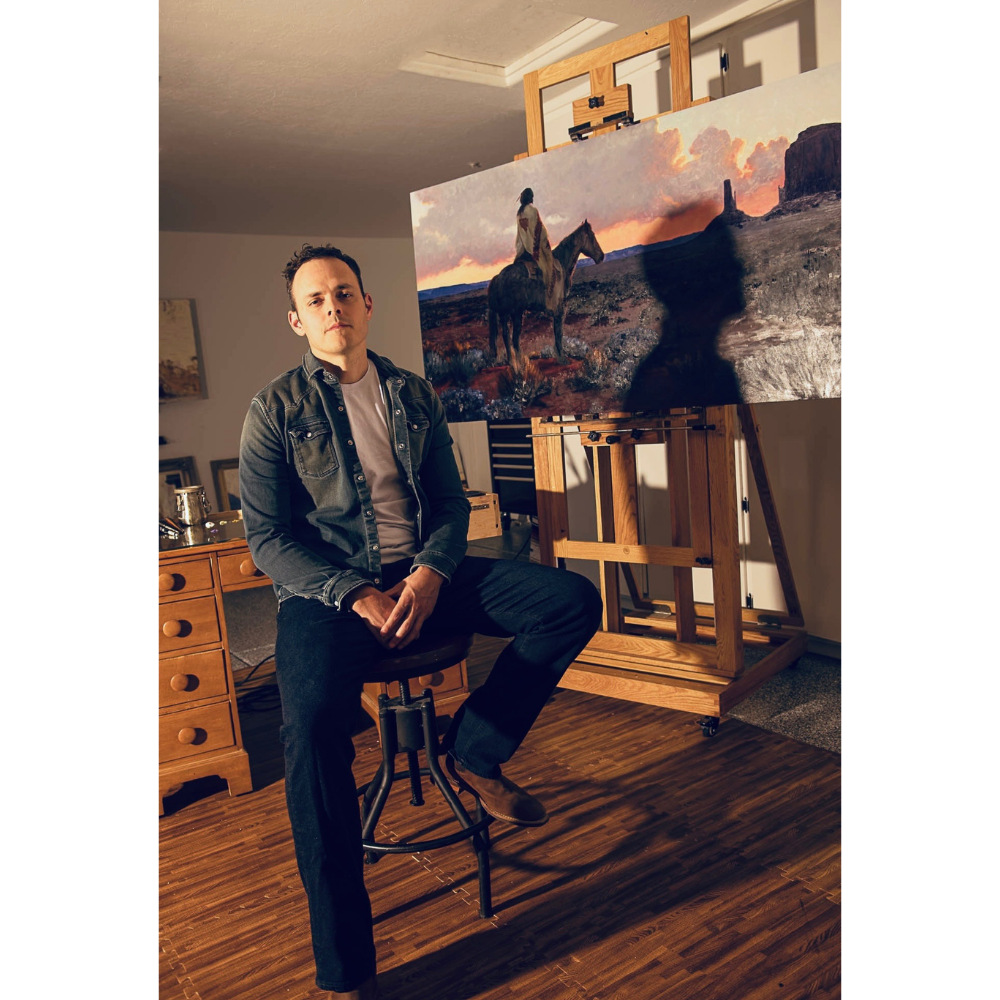
For Tyrel Johnson, the path to becoming a professional artist began in the most immersive way possible: growing up in a family bronze casting foundry. Surrounded by the craft, young Tyrel learned the intricacies of sculpting and scaling up large-scale monuments alongside his siblings. “From a very young age I knew I wanted to be a professional artist, and that’s been my pursuit ever since,” he reflects. But the journey wasn’t linear. When the family foundry closed, Tyrel transitioned into construction, spending nearly 20 years in the trade and eventually becoming a job site superintendent managing custom homes. Those decades weren’t a detour from his dream, but they were preparation. The precision, the understanding of materials, the ability to see a project from vision to completion would later help inform his approach to sculpture. Today, Tyrel creates art that mixes bronze with wood and uses traditional technique with contemporary design all in service of what matters most to him: telling stories that resonate in the heart.
Here at Equine Instincts, we had the pleasure of interviewing Tyrel to learn more about his craft, his journey as an artist, his commitment to authenticity, and his connection through sculpture.
What Does the Creative Process Look Like?
For Tyrel Johnson, sculpture doesn’t always begin with a sketch or a lump of clay. “Generally, it starts with an idea, a phrase, or even a word,” Tyrel explains. “Say I wanted to sculpt something that means ‘kindness.’ I plant it in my subconscious and leave it alone. It’s like you give it away to your head and see what your head does.” This patient approach to creativity, planting seeds and allowing them to grow in their own time, reveals an artist who trusts the process more than he forces it.
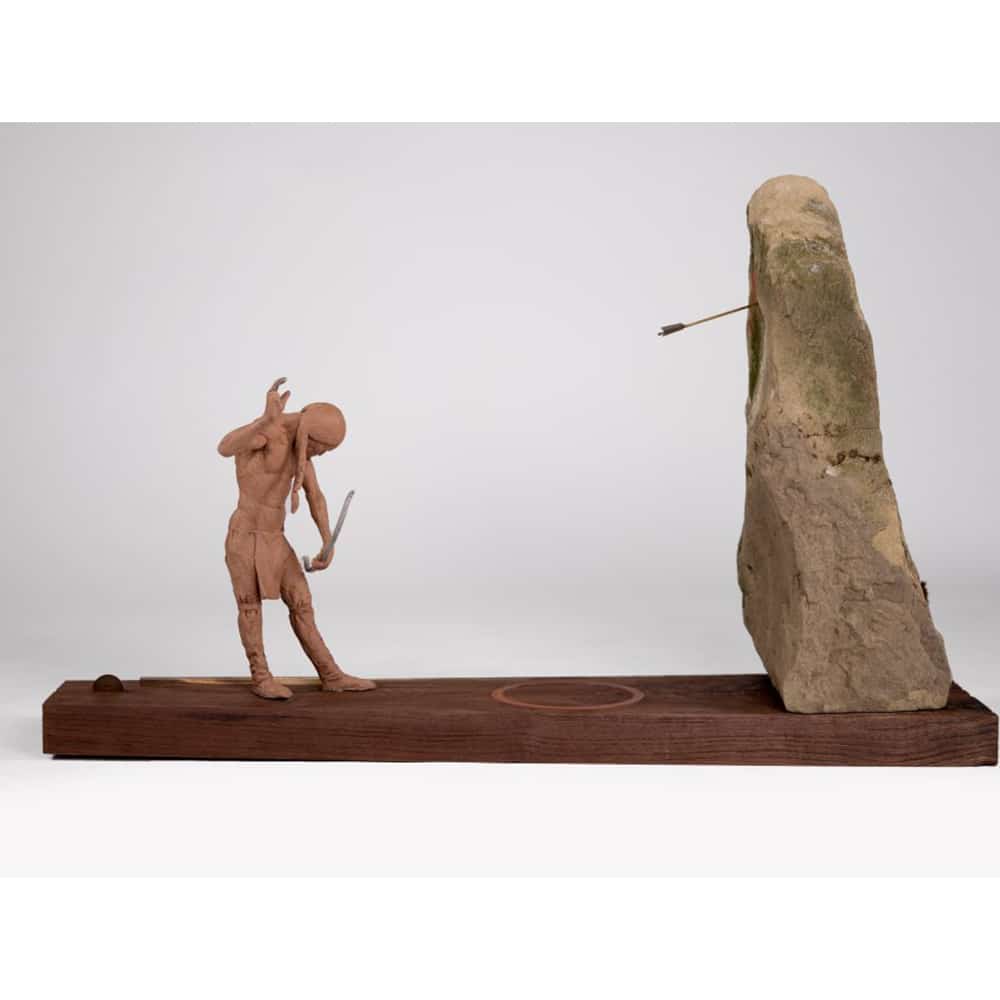
Looking further into the process, Tyrel also takes inspiration for pieces from the mediums themselves. “The different mediums are my way of playing with the idea like a child,” he says. “Growing up in a bronze family, all I saw was bronze, bronze, bronze. I knew I wanted a subject or the figures, or the animals, whatever I’m sculpting, to kind of stand alone amidst what I was pairing with it.” This is how Tyrel began to form his signature combination of bronze sculptures paired with wood elements. The contrast allows each material to shine while contributing to a unified conversation.
But perhaps the most fascinating element of Tyrel’s process is his devotion to the golden ratio. “Another thing I do in my work is everything that I can possibly divide by the golden ratio within a piece is incorporated,” he reveals. It’s this commitment to underlying structure that allows Tyrel’s pieces to feel both spontaneous and deeply intentional. He believes that following the golden ratio dimensions helps pull out what he calls “the beautiful simplicity”, that elusive quality where complexity and clarity meet.
Most Challenging Aspect?
When asked about the most challenging part of his work, Tyrel doesn’t hesitate: “I would say it’s still the sculpting. Because you’re asking your hands to imitate your dream.” This simple statement contains the fundamental challenge of how to bridge the gap between vision and execution. Tyrel spent seven years studying anatomy in depth, not because he wanted to show off technical prowess, but because he wanted to earn the freedom to express himself without limitation. This dedication to craft as a pathway to freedom explains why Tyrel didn’t share his work publicly until he felt truly ready. He wasn’t waiting for perfection; he was working towards allowing his hands to keep pace with his imagination.
Horse of Another Color: Symmetry, Choice, and Cause and Effect
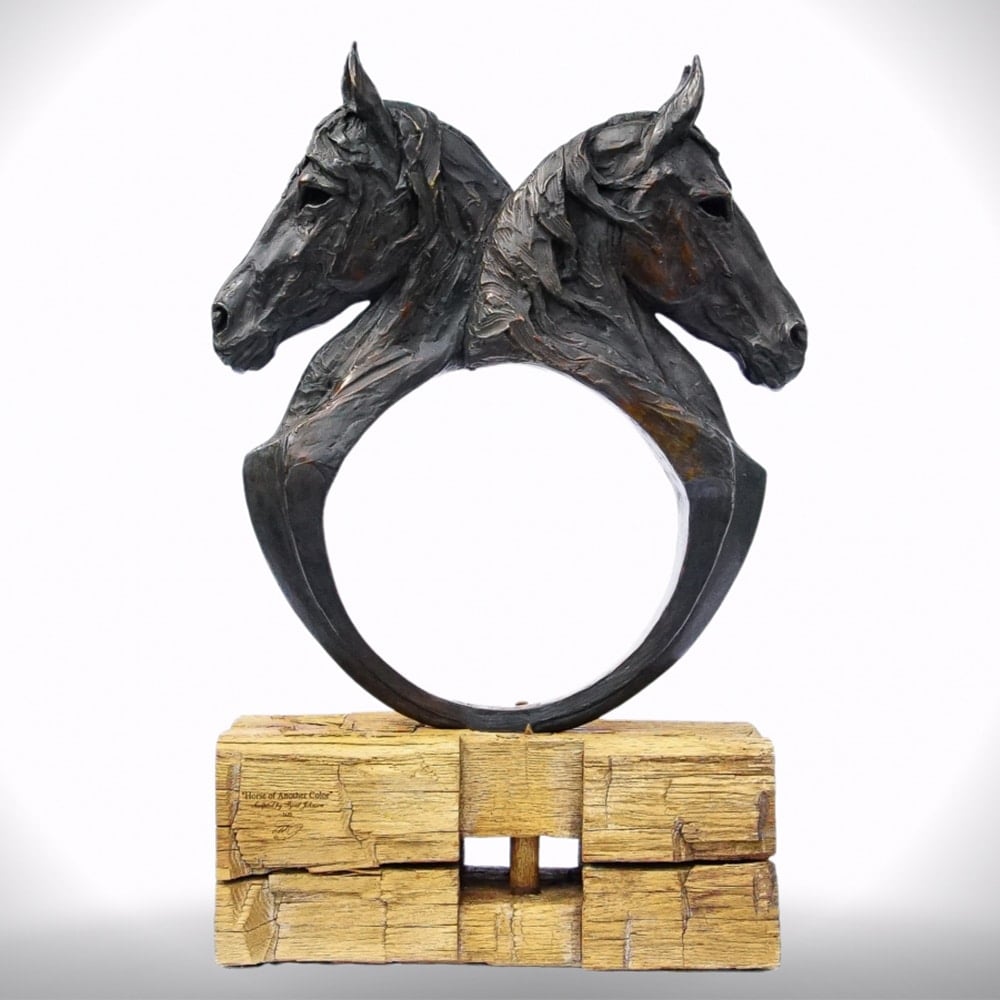
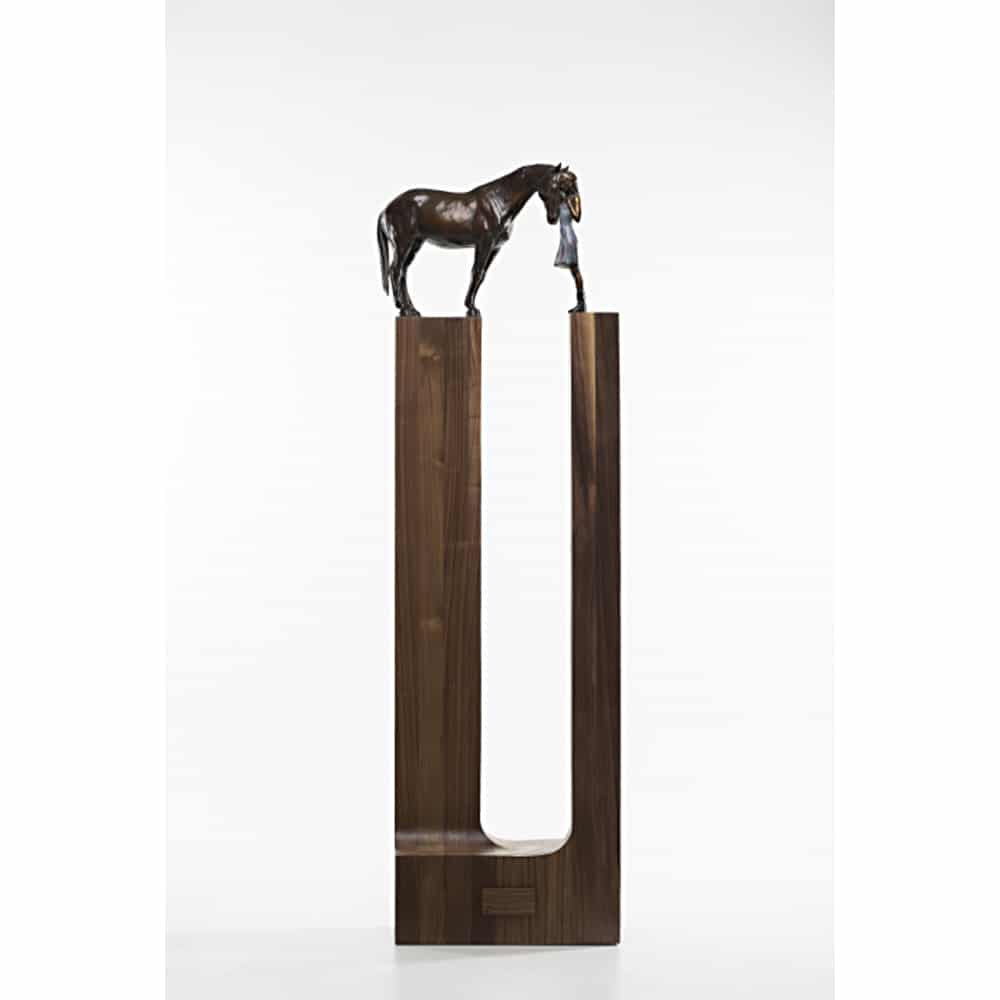
Among Tyrel’s body of work, “Horse of Another Color” stands as a particularly powerful exploration of choice. “I wanted it to have symmetry and balance,” Tyrel says of the piece, but the sculpture offers far more than aesthetic equilibrium. “For me, it represents choice,” Tyrel explains. “The hole in the center is the gap between cause and effect.” That hole of negative space, the absence at the heart of the sculpture, becomes one of the piece’s most powerful elements. It’s where possibility lives, and where we stand in the moment before consequence becomes reality.
When asked why he used horses in this messaging, Tyrel’s answer revealed his deep understanding of animal symbolism. “Horses are unique in the animal kingdom in that they conduct emotions well.” Indeed, anyone who has spent time with horses knows their ability to mirror, amplify, and respond to human feeling. By positioning horses as the pillars on either side of choice, Tyrel suggests that our decisions are deeply emotional acts, not purely rational calculations.
With such an important message, this piece went through multiple iterations before Tyrel felt it achieved what he was seeking while explaining how he “re-did Horse of Another Color three times.” It was with the help of this process that Tyrel started thinking for pieces moving forward, “I’m going back towards letting go a little more with the texture and the mood.” This willingness to start over, to push through versions that did not satisfy him as an artist, demonstrates Tyrel’s commitment to authenticity over efficiency. The final version carries not just the vision of the piece, but the journey of its creation.
A Bird in Hand: Blindfolded Progress and the Necessity of Creation
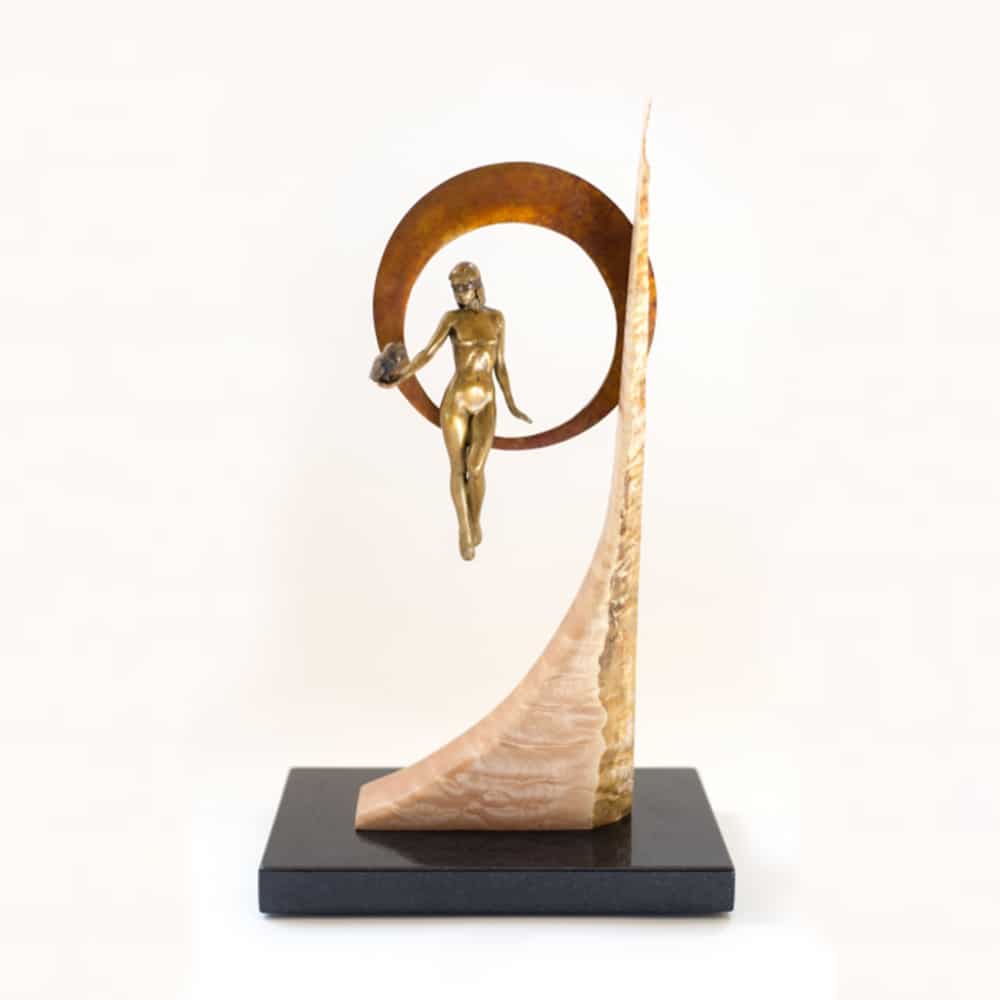
If “Horse of Another Color” explores the space of decision, “A Bird in Hand” confronts the frustration of artistic struggle and the breakthrough that comes through sheer persistence. This piece emerged from a deeply personal moment in Tyrel’s journey, a period when he felt angry that he “hadn’t made much headway in art.” The sculpture represents a turning point, embodying the realization that “all I had to do was sculpt, sculpt more, and sculpt a lot.” There’s a beautiful simplicity in this thought, a return to the fundamental truth about why artists create art—for creation’s own sake.
The blindfold on the woman in the sculpture carries particular significance. It represents, Tyrel explains, “not knowing this realization of just needing to sculpt and create work.” She holds the bird but cannot see it, like when Tyrel was blinded by his own expectations and frustrations. There’s a vulnerability in “A Bird in Hand” that makes it particularly moving. Tyrel isn’t presenting himself as an artist who has always known his path or never questioned his choices. Instead, he’s offering a sculpture born from a breakthrough and invites viewers into that private moment of recognition.
How Tyrel Wants Collectors to Experience His Work
When asked how he wants collectors to react to his sculptures, Tyrel’s answer was immediate and direct: “Authenticity.” He expands on this, saying, “I don’t want it to be my status regardless of if I’m at the tippy top or not. I don’t want to put on a mask for anyone and I don’t want them to do that with me as well.” This insistence on genuine connection over status or performance explains why Tyrel’s work resonates so deeply with those who encounter it. He made a decision years ago, he shares, that “I wanted to sculpt positive things that tell a story that reach a person in their heart.” Tyrel wants to connect from a place where we’re most vulnerable and most honest.
That same authenticity extends to how he views his own artistic journey. Reflecting upon his artwork, Tyrel mentioned, “I want to look back at my work and see the continuation but also the constant evolution of me… I want to grow, and I want my art to grow with me.” This commitment to evolution, to being in motion rather than arriving at a destination, shapes how Tyrel approaches his work and stays authentic to his creations.
The Artist Behind the Work
In perhaps the interview’s most lighthearted moment, when asked the fun questions of what flavor of ice cream he would be, Tyrel answers with “Moose Tracks: fudge swirls with peanut butter cups and vanilla ice cream.” It’s a telling choice, not a single plain flavor but a combination, something classic (vanilla) elevated with unexpected elements (peanut butter cups) and bound together with richness (fudge swirls). In many ways, it’s a perfect metaphor for his sculptural approach: traditional bronze work elevated with wood elements and bound together with meaning.
Art That Lives Where You Live
At Equine Instincts, we don’t just showcase art, we connect collectors with pieces that speak to who they are and how they live. Tyrel Johnson’s work embodies the values of authenticity, craftsmanship, and emotional connection. Explore more of his artwork online at equineinstincts.com or in person at our Pop-Up gallery outside of Indoor Arena 2 at the World Equestrian Center.