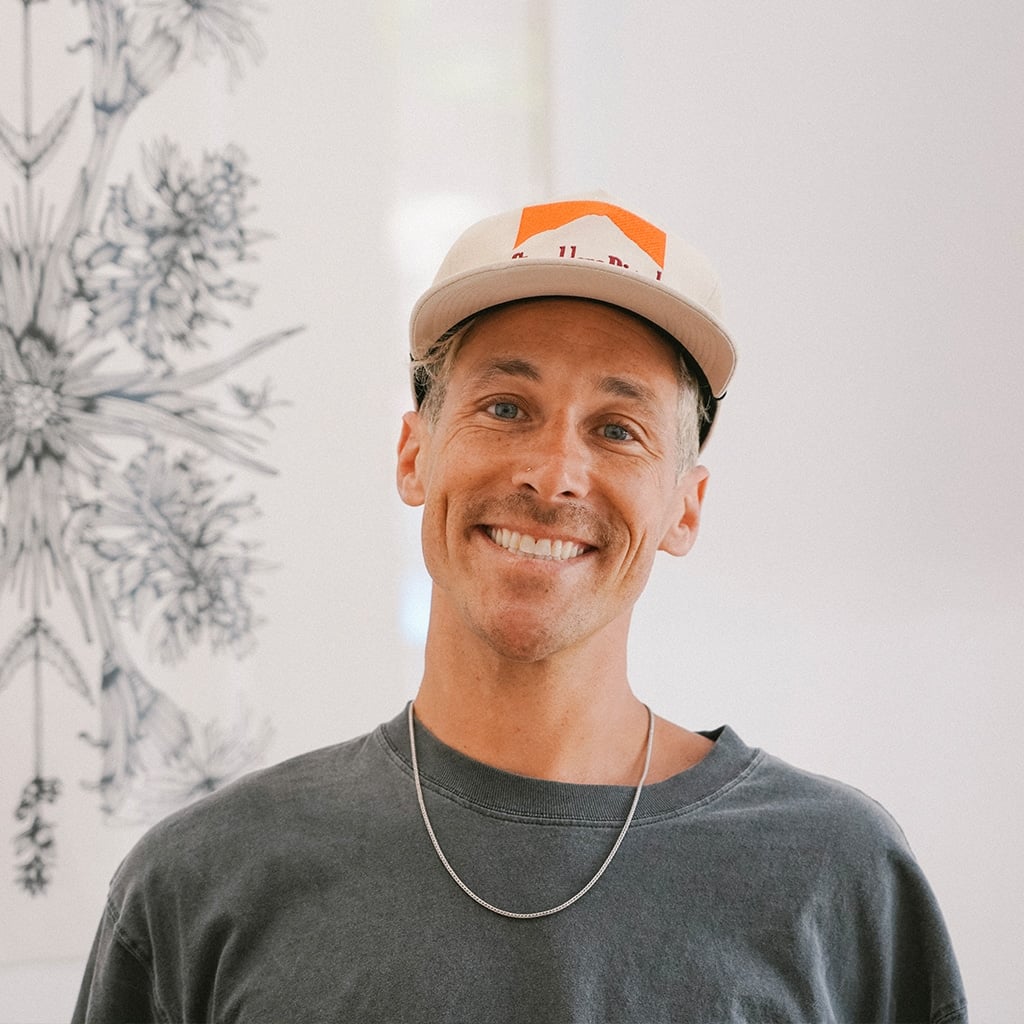
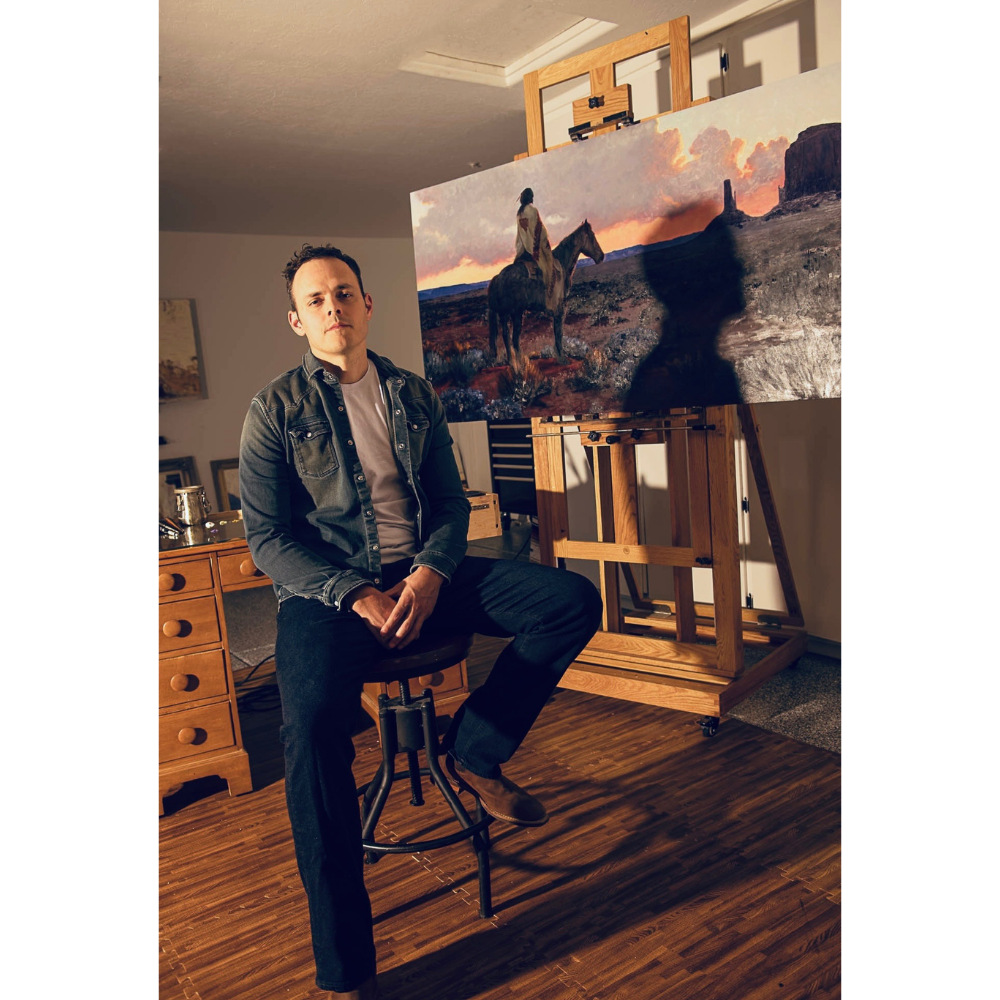
For Whit Boucher, art begins where nature and geometry meet. Working primarily in detailed pen and ink, Whit creates intricate mandala-like compositions inspired by the wild beauty of Colorado’s high alpine plants. His vortex patterns draw the eye inward, inviting viewers to discover new details within every inch of the piece. But Whit’s artistic practice extends beyond the pen. He’s also a muralist, having created large-scale works for the Aspen Skiing Company and local restaurants, proving that his precise, intricate style translates powerfully to any scale.
Whit’s journey to becoming a full-time artist began with graphic design, where he learned the technical skills that now shape his unique creative process. That foundation in digital tools allows him to achieve a level of symmetry and precision that would be nearly impossible by hand alone, while his artistic instincts keep the work feeling organic.
What Does the Creative Process Look Like?
Whit’s process is a comprehensive mix of old-school hand drawings and the usage of modern digital tools. He starts with creating individual drawings and then uses his background knowledge from being a graphic designer to turn his work into graphics. From there, Whit will build a bigger form on the computer and ensure that there is perfect symmetry. Once printed, Whit once again picks up his pen and now has a road map for what the final piece should look like. This hybrid approach allows him to achieve the precise details that defines his work while maintaining the organic energy of hand-drawn art.
When creating the final piece, Whit follows a particular pattern, stating, “I usually start my pieces in the middle and work outwards.” He begins in pencil, carefully building the foundation of each intricate pattern, then goes over everything in pen to create those crisp, bold lines. Gold leaf application comes last, added to enhance that final layer of dimension and light.
When it comes to inspiration throughout the process, Whit is entirely visual. He photographs plants and flowers that catch his eye, focusing on local flora found in Colorado’s high alpine environments. These photographs become references, but the final compositions go beyond documentation; he creates arrangements that capture the essence and energy of the natural world.
The Beauty of Gold Leaf
If there’s a signature element in Whit’s recent work, it’s the incorporation of gold leaf. “The gold leaf was directly inspired by plant medicine,” Whit reveals, speaking to the deeper spiritual connections that inform his art. He’s also been drawn to reflective elements, fascinated by how light interacts to create the illusion of depth on a flat plane.
The technique’s impact comes from how the materials play off each other. The reflective gold leaf layered on textured watercolor paper ads an extra layer of depth when topped with dense black ink. “When the black is over the gold leaf, it really pops and looks like it’s coming off of the paper,” Whit notes. This dynamic between light and darkness, between reflective and absorbent surfaces, captivates viewers experiencing the work firsthand.
Most Challenging Aspect?
When asked about the most difficult part of his practice, Whit identified two challenges: maintaining symmetry and the sheer tediousness of the work itself. His immediate response of “keeping everything symmetrical” requires constant focus and precision, especially when working at large scales. But there’s a gift hidden within that challenge in Whit’s eyes. “You can almost go into this meditative state,” he says of the repetitive, detailed work.
Perhaps the most technically demanding moment comes after the digital design phase. Once Whit prints his drawings to scale, he faces the task of replicating them onto thick watercolor paper. He must now transfer all those intricate details from the printed guide to the final surface and eventually apply gold leaf. It’s a moment where one mistake could compromise hours of work, requiring both technical skill and steady nerves.
How Whit Wants Collectors to Experience His Work
When asked how he wants collectors to react to his drawings, Whit’s answer reveals both his conceptual and technical ambitions. “I want them to be intrigued about what the form means,” he says, speaking to the deeper symbolism and energy he weaves into his patterns. But equally important, “I want them to be inspired by the craftsmanship.”
And the high level of craftsmanship is evident. These aren’t pieces you can fully appreciate from across the room or scrolling past on a phone. They demand closer viewing, rewarding the audience who takes the time to trace the intricate lines and discover how each element connects. After fully exploring the piece, Whit explains, “You can see the time and effort put into these.” That visible labor, the evidence of human hands and patience, creates an added level of connection to the work and pulls you in.
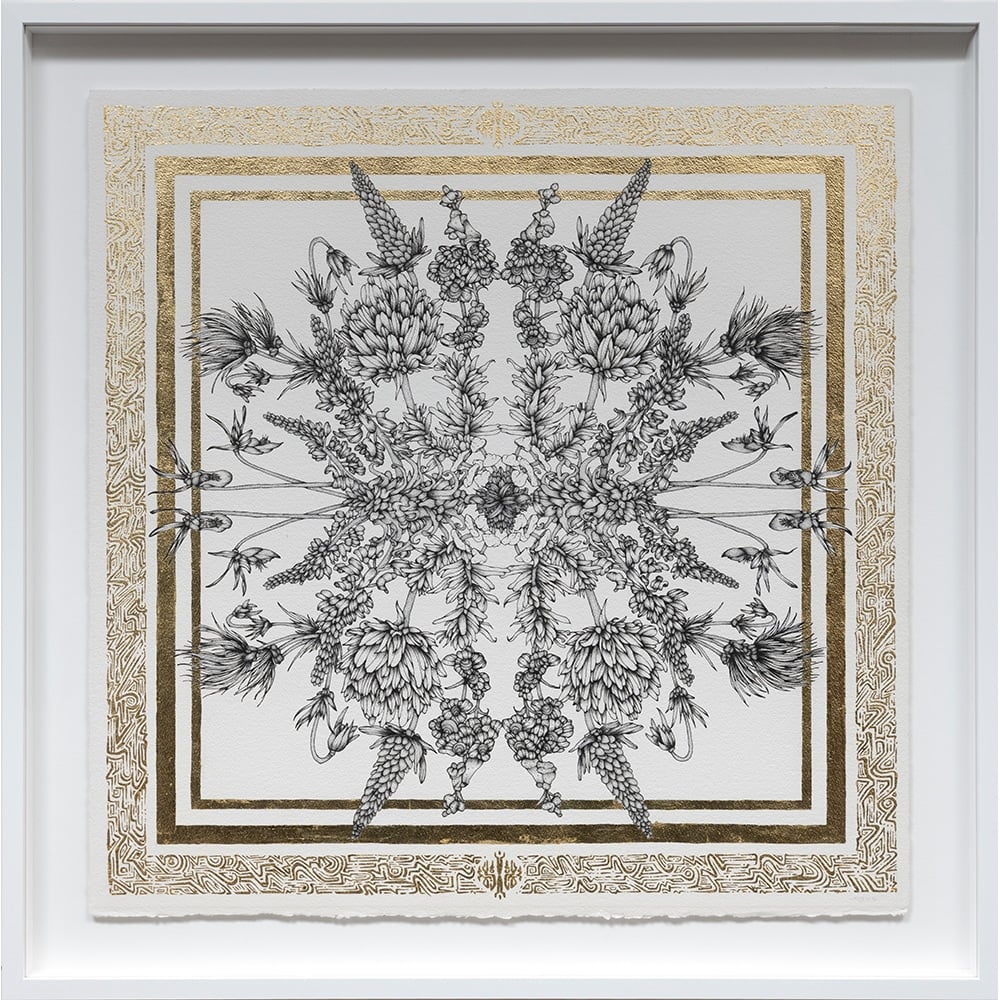
Floral Vortex 4
Among Whit’s body of work, “Floral Vortex 4” stands as a particularly successful exploration of energy and form. “I try to make some of them more feminine feeling, and I feel like that one captured it well with the longer, wispy plants that stick out,” Whit explains. Like all his vortex pieces, this work takes inspiration from local Colorado flora; resilient flowers that can bloom briefly and brilliantly in harsh alpine conditions.
More than anything, Whit explained that this piece reflected his time spent outside and surrounded by nature.
Moving Forward: Evolution and Experimentation
Whit refuses to stay static. Rather than resting on his success, he is boldly evolving his practice, pursuing fresh experiments, and expanding his work across multiple creative avenues.
The gold leaf he’s been incorporating continues to fascinate him, and he’s exploring how far he can push that contrast. Whit is also beginning to experiment with watercolor, testing how color might interact with his typically monochromatic work. But perhaps the most exciting technical evolution involves VR technology. Whit plans to use VR goggles to help level up his artwork, building images in the computer to scale and then displaying them virtually in front of him through the goggles. “It would really speed up the process and I could just be able to go,” he explains, seeing this as a way to maintain precision while speeding up the creation process.
And there’s one more expansion on the horizon: starting in December, Whit will begin a tattoo apprenticeship. He’ll practice this new form alongside his pen and ink pieces and mural work. “It’ll be cool to add that to the repertoire,” he says with excitement. The technical skills will translate naturally, with the same steady hand, the same attention to detail, and the same ability to work at different scales.
Keeping these evolutions in mind, Whit stated, “My work will continue to be a visual exploration of energy.” Whether that energy manifests in alpine flowers, geometric vortexes, or eventually in tattoos, the core remains the same: capturing and translating the invisible forces that move through the natural world.
The Artist Behind the Work
In the final question, when asked what flavor of ice cream he would be, Whit answered without hesitation and with straightforward reasoning. “Pistachio. I love pistachios. It’s my favorite nut, it’s my favorite ice cream flavor, and I like the color.” These specific and immediate details are particularly telling for a visual artist. Even in a playful question about ice cream, Whit’s eye goes to aesthetics and gravitates towards color and form. The pale green connects back to Whit’s experiences and all of the time he’s been outside observing nature. It’s a small detail that reveals how deeply his environment has shaped his artistic vision.
Art That Lives Where You Live
At Equine Instincts, we don’t just showcase art; we connect collectors with pieces that speak to who they are and how they live. Whit Boucher’s work embodies the values of patience, precision, and the profound beauty found in nature’s patterns. Explore more of his artwork online at equineinstincts.com or in person at our Pop-Up gallery outside of Indoor Arena 2 at the World Equestrian Center.